
How a Delaware County Property Search Works
Delaware County record detail
- Delaware County record detail]
- Delaware County record detail
- Delaware County record detail
- Delaware County record detail
- Delaware County record detail
What a Delaware County Property Record Shows
Delaware County record detail
| Owner of Record | Delaware County record detail |
|---|---|
| Situs / Mailing Address | Delaware County record detail |
| Parcel Number (APN) | Delaware County record detail |
| Assessed / Market Value | Delaware County record detail |
| Legal Description | Delaware County record detail |
| Last Sale | Delaware County record detail |
Delaware County record detail
Search by Address, Owner, or Parcel
Delaware County record detail
| Search Key | Best For | Where It Works | Watch Out |
|---|---|---|---|
| Address | Delaware County record detail | Delaware County record detail | Delaware County record detail |
| Owner name | Delaware County record detail | Delaware County record detail | Delaware County record detail |
| Parcel number | Delaware County record detail | Delaware County record detail | Delaware County record detail |
Not a title search. Delaware County record detail
Resolve the Delaware County Municipality Before Searching
Jurisdiction comes first in a Delaware County property search. Nineteen towns prepare the assessment rolls. Ten villages layer on their own municipal context. No incorporated city exists anywhere in the county. A ZIP code or hamlet name never substitutes for the assessing town. Verify the town before touching a roll. Deposit even straddles the Delaware and Broome county line. That is why county, town, SWIS code, and parcel number should all line up. Keep the punctuation intact in parcel numbers like 54.14-1-3 and 330.-1-26.5.
What a Delaware County Roll Result Returns
The assessment PDFs split Current Owners Name and Current Owners Address into separate fields. Around those, each line carries location, class, and acreage. It also lists account, school and tax districts, and assessment amounts. Exemptions, taxable values, and full-market value appear too. Many entries also include the deed book and page. Treat a mailing address as exactly that, not as evidence anyone lives at the parcel. The deed reference is a bridge to the Clerk's instrument. It is not a stand-in for reading it. The county's official assessment-roll page presents the town and year choices. Open the official assessment-roll source.
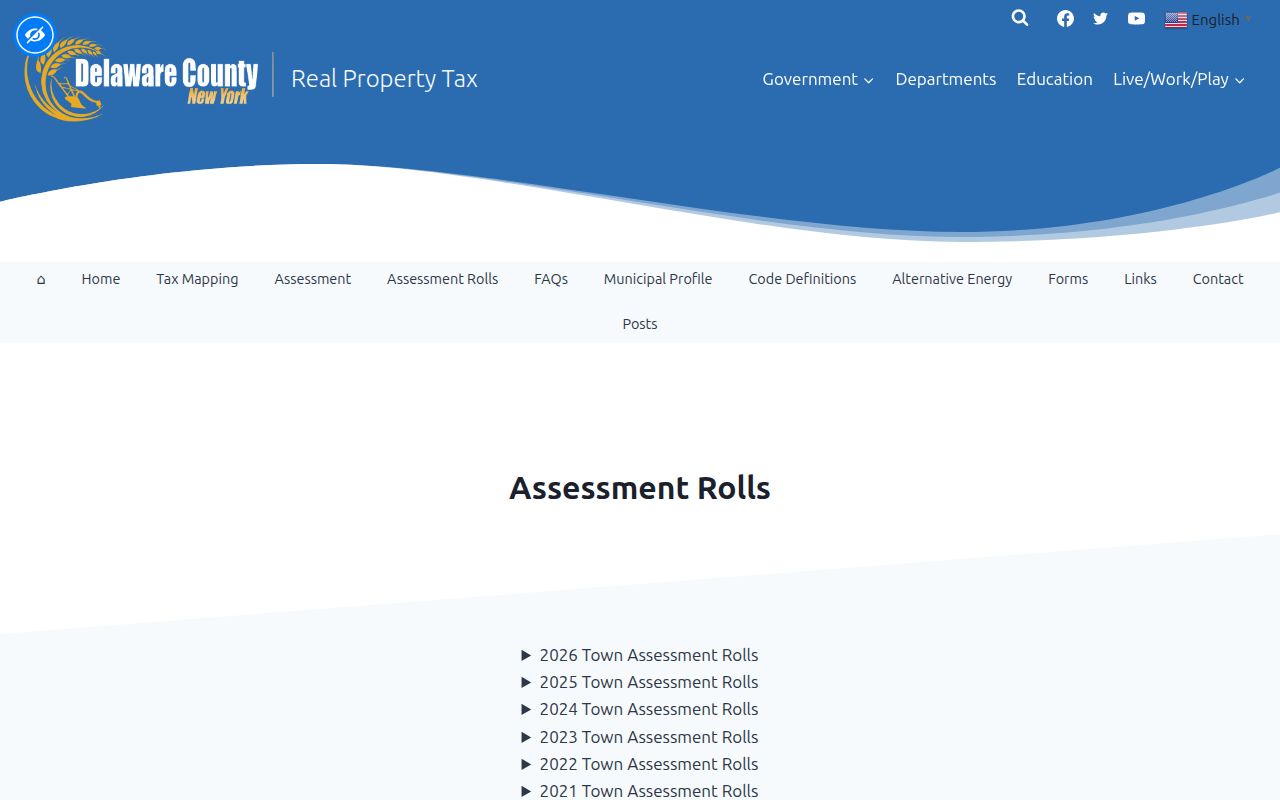
The county's official roll page displays the town and year selections, which shows why picking both correctly is essential to a reliable search.
Carry the Owner to the Delaware County Deed Index
Treat the roll owner as a lead, nothing more. Search that party as grantee in SearchIQS. Then match the latest conveyance to the parcel and its legal description. Deed records carry index and image coverage from 1991 forward. Historical indexing stretches back to 1797, though older images run only partial. Guest searching works without payment. Paid time plans and a per-image download or print charge appear on the account page. Review SearchIQS access plans.
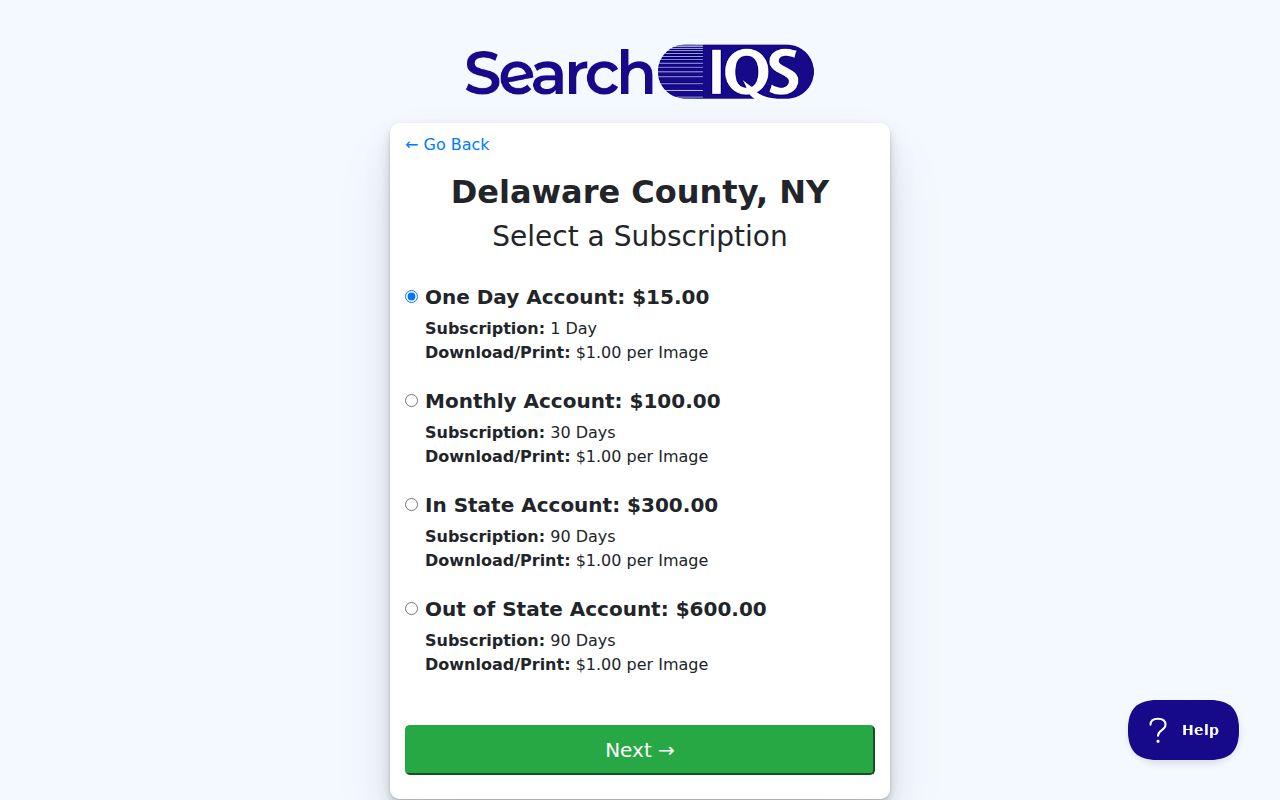
This capture helps separate free index exploration from paid image retrieval.
Use Delaware County Fallbacks When a Search Field Is Missing
The county publishes no countywide public search-by-street browser. For a block study, find the subject parcel in C.O.M.I.T. Jot down the adjacent parcel IDs, and confirm each one against the town roll. Real Property Tax Services takes information requests covering owner, location, class, acreage, sale, and output preferences. Its form lists a $50 minimum report fee. For anything outside online coverage, write the Clerk with party names, approximate dates, and a book/page citation if you have one. Same-name confusion is a real hazard. Match municipality, parcel, account, legal description, and recording reference instead of trusting a name alone. Addresses protected under New York's Address Confidentiality Program must never be reverse-engineered.
Search Delaware County Encumbrances Separately
An assessment roll is not an encumbrance history. Mortgages, liens, judgments, easements, and releases each live in the Clerk's index, so search there by every relevant party and date range once the parcel and owner are pinned down. Read the originating document and every later satisfaction, discharge, assignment, or release too. An old mortgage sitting in an index proves nothing about a current balance. Litigation runs on its own track. WebCivil Supreme generally covers matters carrying an RJI in the statewide system. Town and village justice cases may require a call to the local court clerk. Probate authority surfaces through WebSurrogate or the underlying Surrogate's Court file. Keep those case systems apart from the land index. Connect them only through a matching party, parcel, judgment, or recorded instrument.
Order Delaware County Results That Are Not Online
Build a tight request before you call. Include the owner's full name, alternate spellings, town, and approximate years. Add the parcel number and any book/page reference. The County Clerk handles deed books, maps, court files, certified copies, and historical holdings. Real Property Tax Services covers rolls, mapping, and custom assessment data. Assessors and local collectors still matter for current municipal details. Ask what form the answer takes. An index entry, an uncertified image, a certified copy, and a custom report all differ. Each carries different evidentiary weight and different cost. The Clerk's fee schedule effective October 6, 2025 splits many charges. It lists recording, copy, certification, map, lien, and other fees. The RPTS custom-report form states its own minimum. Confirm the current schedule before ordering, because a dated fee is never permanent.
Keep a Delaware County Search Log
Keep a log from the first keystroke. Write down every spelling tried and the town selected. Record the parcel number, SWIS code, roll year, and deed reference. Distinguish the situs address from the owner's mailing address in your notes. When a result fails, record why. A portal returning no match, a missing image, and a year outside coverage are three different problems. Each calls for a different fallback. The log pays off most after a recent ownership change. Compare the roll snapshot against the deed recording date. Then simply revisit the next roll rather than guessing at update timing. For older work, carry book/page and legal-description clues into microfilm. The same clues open historical books, maps, court series, and library collections. That discipline turns a broad property search into a reproducible chain of official findings.
Search Each Delaware County Record System With Its Native Key
Each system answers to its own key. The roll prefers the municipality and tax map number. Owner or location serves as backup inside the PDF. SearchIQS leans on parties and recording references. C.O.M.I.T. thinks spatially, so a selected polygon and its surrounding map context carry the weight. The collector wants the levy year plus its own parcel or bill key. The courts run on party and case controls. Carrying a single identifier across systems helps. But plan on adding whatever key the destination demands.
Start from the least ambiguous source you have. An exact parcel number beats a loose street spelling almost every time. An owner name works better once town and parcel controls narrow it. An address should be confirmed as the property location rather than the mailing address. Try the common name variants. Hold off on merging anything until a legal description, deed reference, account, or map confirms the match.
Interpret a Delaware County Search Result by Its Date
Dates on a result label different events. Roll year, valuation date, taxable-status date, recording date, instrument date, map revision date, and levy year each describe a distinct moment. Roll year marks the assessment cycle. Valuation date pins the appraisal snapshot. Taxable-status date, recording date, instrument date, map revision date, and levy year each capture their own moment too. A new deed can post after an assessment snapshot was taken. A tax map may show a later split than an old deed reflects. A current collector can carry an open bill while the Treasurer holds only delinquent years. Set each result on this timeline before calling it stale or inconsistent.
The 2026 Stamford example makes the point. Its valuation date is July 1, 2025, and its taxable-status date is March 1, 2026. Those labels pin down the value and exemption snapshot. They do not mark the exact day the owner field was refreshed. The county publishes no fixed countywide owner-update lag. So treat the roll as possibly behind. Compare it against the latest recording before drawing conclusions.
Recognize the Limits of a Delaware County Property Search
No single record tells the whole story. A roll omits many easements, mortgages, liens, restrictions, occupants, and beneficial owners. A deed index does not certify clear title. A GIS polygon is not a survey. A full-market estimate is not an appraisal. A recorded consideration amount is not always an arm's-length price. A court index can leave out files or details that stay with the clerk.
Those limits point to fallbacks rather than a dead end. Pull the deed image or a certified copy. Search related releases. Order the relevant map. Consult the local assessor or inspect the court file. Engage the appropriate professional when the stakes call for one. New York FOIL covers reasonably described agency records where no routine portal or form fits. It remains subject to applicable exemptions and privacy protections.
Before closing a search, test the result against one independent county source. Match a roll owner to the deed. Match a mapped parcel to the roll, a sale reference to the recorded instrument, or a delinquent balance to the Treasurer route. Record any unresolved difference plainly. An answer that states what was checked, when it was effective, and what remains unknown beats an unqualified one. An unqualified one is assembled from a single portal.